Transform your VPN from a static entry point into a responsive security gateway. Cloud RADIUS integrates directly with your existing IdP, MDM, and security platforms to ensure only healthy, verified devices can establish a tunnel.
Certificate-based VPN authentication that eliminates tokens and password-related support tickets.
Passwords and MFA tokens create friction for users and risk for your organization. Cloud RADIUS validates hardware-backed certificates in real time against live identity and device posture signals.
| Feature | Legacy VPN Architecture |
Cloud RADIUS Architecture
|
|---|---|---|
| Trust Model |
“Assume Trust” once a password is entered correctly.
|
“Verify Explicitly” using hardware and identity telemetry.
|
| Integration |
Siloed authentication requiring on-prem LDAP/AD servers.
|
Direct, cloud-native integration with Okta, Google, and Entra ID.
|
| Endpoint Scope |
Limited control over unmanaged or personal BYOD devices.
|
Secure, guided onboarding for every device type and OS.
|
| Scalability |
Complex, multi-site sync issues with physical RADIUS.
|
Global, high-availability cloud footprint with 99.999% uptime.
|
Cloud RADIUS anchors your network edge to your existing security stack to automate access decisions, allowing your IT staff to focus on high-value initiatives rather than password resets and token troubleshooting.
Drop IT Support Overhead
Automated certificate lifecycle management means no more manual password resets or MFA troubleshooting.
Frictionless Connectivity
Certificates create an invisible, seamless connection — keeping distributed teams productive without security interruptions.
Real-Time Governance
Automatically revoke VPN access the moment an employee’s status changes in your identity provider.
Eliminate Password Risk
Eliminates stolen credentials, a major cause of data breaches, ensuring your VPN isn’t an open door for lateral threat movement.
Access decisions should reflect the actual state of your users and hardware. Here’s how our dynamic approach allows enterprise teams to enforce granular, posture-aware security across remote endpoints.
A seamless path for trusted users on compliant hardware — similar to architectures deployed by global employment platforms and distributed financial services firms.
STEP 1
Device Request
Remote user initiates a VPN connection via a hardware-backed certificate provisioned through Intune or Jamf.
STEP 2
Live Identity Status
Cloud RADIUS performs a real-time lookup in Okta or Entra ID to confirm the user is active and authorized.
STEP 3
Posture Validation
The system cross-references the MDM to verify the device is encrypted, patched, and running a required security agent.
STEP 4
Corporate Access
Access Granted. The user enters the primary Corporate VLAN seamlessly — no tokens, no prompts.
Automatically isolates devices that fall out of compliance — a critical requirement for meeting NIST 800-53, HIPAA, and SOC 2 audit standards in healthcare and public sector environments.
STEP 1
Certificate Presented
An employee attempts to connect using a valid digital certificate tied to their identity.
STEP 2
EDR Telemetry Check
Cloud RADIUS identifies the user but detects a Medium Risk Score from CrowdStrike or SentinelOne.
STEP 3
MDM Policy Assessment
The policy engine notes the device is missing a required security update flagged by the MDM.
STEP 4
Quarantine Segment
Restricted Access. The device is automatically segmented into a Remediation VLAN with no access to sensitive data.
A contractor is offboarded in your IdP, but still has a valid certificate on their device.
STEP 1
Connection Attempt
A recently offboarded contractor attempts a VPN connection using a still-valid certificate.
STEP 2
Directory Verification
Cloud RADIUS queries the cloud directory in real time and finds the account status is Disabled.
STEP 3
Policy Override
Within milliseconds, the policy engine overrides the certificate’s validity based on the live identity signal.
STEP 4
Connection Blocked
Access is denied globally, regardless of physical location — no manual certificate revocation required.
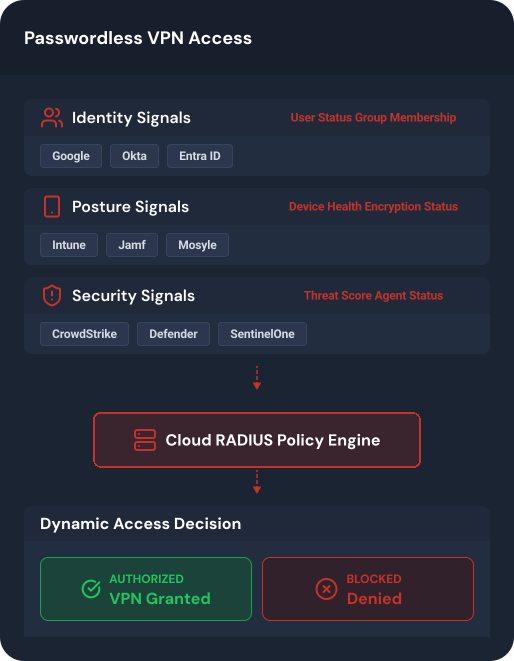
Use native integrations and standard protocols to connect cloud identity, device management, and security telemetry to RADIUS authentication.
Cloud RADIUS handles every network authentication scenario. Explore the capabilities that matter most to your organization.
Assign VLANs, ACLs, and network roles dynamically based on user identity, device posture, and compliance status — eliminating static, manually managed network rules.
Serve multiple customers or business units from a single Cloud RADIUS deployment with complete tenant separation, dedicated policies, and centralized management.
Replace shared secrets and password-based EAP methods with hardware-bound certificates for secure, frictionless Wi-Fi and wired authentication across your infrastructure.
Apply identity and device posture checks at VPN connection time using certificate-based authentication — no passwords, no MFA fatigue, no credential theft.
Give personally owned devices the same phishing-resistant EAP-TLS access as managed devices, through a self-service onboarding flow that requires no MDM enrollment or IT intervention.
Deploy Cloud RADIUS across multiple regions with automatic failover, load balancing, and elastic scaling — ensuring network access is never interrupted.
Provide visitors, contractors, and temporary users with isolated, policy-controlled network access — authenticated through your existing identity provider with automatic expiration and full audit trails.
Combine identity, device posture, and security signals in real time to enforce dynamic access policies — granting, restricting, or revoking network access based on who, what, and how compliant the connection is.
Establish a modern remote perimeter where access decisions reflect the real-time health and identity of every device.